
Webb Reveals the Lion Nebula in Stunning Infrared Detail
August 14, 2026 | By Unified Field Press
This week brought a useful mix of deep-space imaging, heliophysics data, lunar impact science, and spacecraft engineering. The common thread is measurement: better images, newly opened datasets, a well-constrained artificial impact, and a practical attempt to extend the life of an orbiting observatory.
Here are four developments worth keeping, with the evidence separated from the headlines and the primary NASA sources linked directly for follow-up.
The Week’s Big Picture
NASA’s newest Webb image shows how infrared observations can expose structures that visible light only hints at. At the same time, IMAP has begun opening a new stream of heliophysics measurements to researchers, Swift is being prepared for an unusual commercial orbital rescue, and a spent Falcon 9 upper stage has given lunar scientists a rare impact event with a documented launch history and predicted trajectory. None of these stories rewrites physics by itself. Together, they show how much scientific progress comes from improving what we can see, measure, and compare against a prediction.
Webb Gives the Lion Nebula a New Infrared Face
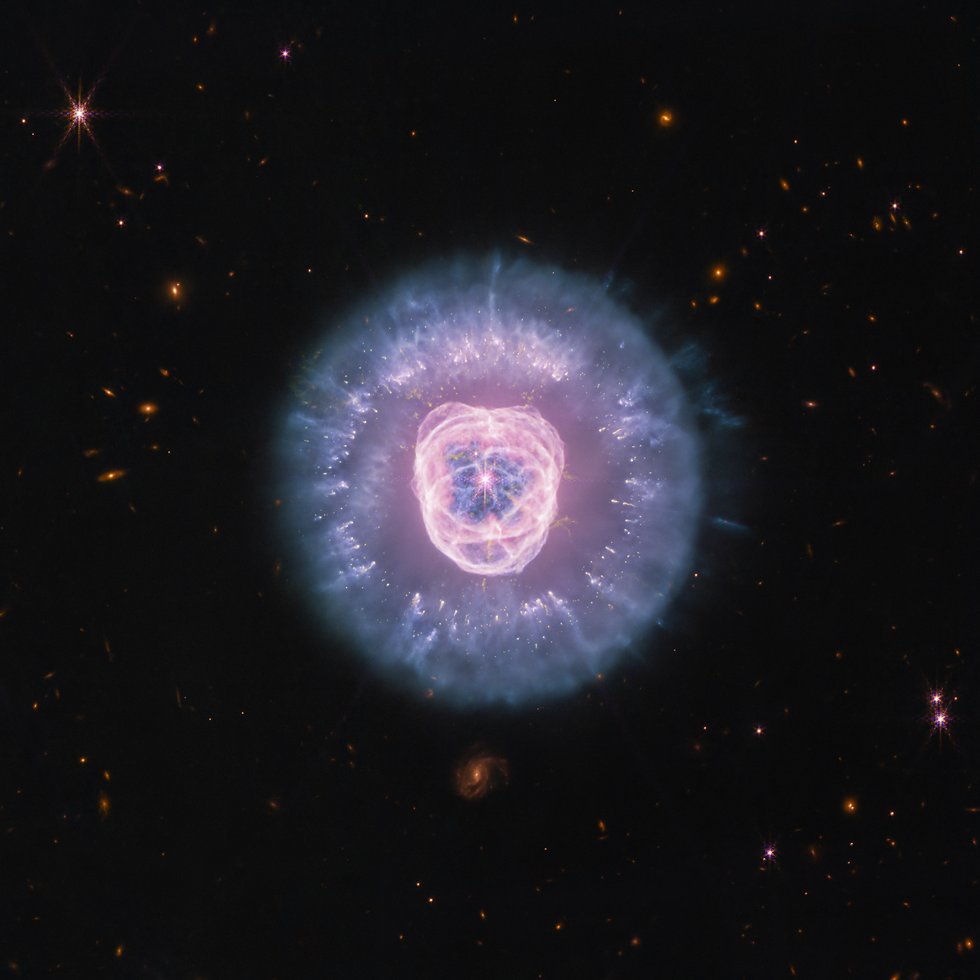
NGC 2392, the Lion Nebula, imaged with Webb’s NIRCam and MIRI. Credit: NASA, ESA, CSA, STScI; image processing: Alyssa Pagan (STScI).
What happened
NASA released new James Webb Space Telescope views of NGC 2392, a planetary nebula nicknamed the Lion Nebula. Webb combined observations from its Near-Infrared Camera and Mid-Infrared Instrument, resolving a hot white dwarf at the center, bubbles and shell-like rings of ionized gas, and a broad dust structure that forms the nebula’s apparent “mane.”
Why it matters
Hubble previously imaged the object in visible light, but Webb’s infrared sensitivity makes compact dust clumps and ionized gas easier to distinguish. That matters because planetary nebulae are not static decorations. They are short-lived stages in stellar evolution, shaped by radiation and outflow from a dying star. In NGC 2392, the central white dwarf is actively ionizing gas while radiation erodes some dust and denser clumps protect material behind them.
What the evidence supports
This is an observational mission release, not a claim that a new physical law has been discovered. NASA describes the gas bubble as expanding and the surrounding dust as being reshaped by the central star’s radiation. Astronomers estimate the nebula will disperse on a timescale of roughly 10,000 years. Primary source: https://science.nasa.gov/missions/webb/lion-nebula-roars-to-life-with-nasas-webb/
A Falcon 9 Upper Stage Became a Lunar Impact Experiment
What happened
NASA’s Center for Near-Earth Object Studies calculated a 100 percent impact probability for the spent Falcon 9 upper stage launched with Firefly Aerospace’s Blue Ghost Mission 1 in January 2025. NASA expected the stage to strike the Moon on August 5 near the Einstein and Bell crater region. Before the event, NASA identified the Lunar Reconnaissance Orbiter and South Korea’s ShadowCam as spacecraft that might be able to image the site before and after impact.
Why it matters
Artificial lunar impacts are useful because the incoming object is much better characterized than a random natural meteoroid. Researchers know the launch, can reconstruct the trajectory, and can estimate the object’s mass and speed. NASA’s pre-impact estimate suggested a crater roughly 60 feet across and about 12 feet deep. Comparing a later observed crater and ejecta pattern with those predictions can improve models of how impacts excavate lunar material.
What the evidence supports
NASA’s page supports the predicted impact geometry, probability, expected crater scale, and planned orbital observations. A confirmed post-impact crater image should be treated as a separate result once the relevant mission team publishes and identifies it. Primary source: https://www.nasa.gov/humans-in-space/commercial-space/nasa-will-attempt-to-observe-rocket-parts-lunar-impact/
IMAP Opens Seven Instruments’ Data to the World
What happened
NASA announced that all 10 instruments aboard the Interstellar Mapping and Acceleration Probe are collecting data, while public datasets from seven instruments covering observations through April 30 are now available. The released instruments include MAG, SWAPI, HIT, GLOWS, SWE, CoDICE, and IDEX.
Why it matters
IMAP is designed to study the boundary region where the heliosphere meets the local interstellar environment and the processes that accelerate energetic particles. Opening multiple instrument streams gives outside researchers the ability to compare magnetic fields, solar-wind plasma, energetic particles, ultraviolet glow, and dust measurements rather than relying on one sensor in isolation. IDEX is especially interesting because it measures both interplanetary and interstellar dust grains reaching the spacecraft.
What the evidence supports
This is a NASA data-release milestone, not yet a single scientific conclusion. Its significance is that the observational base is becoming available for analysis, including near-real-time I-ALiRT products alongside the archived science data. Primary source: https://science.nasa.gov/blogs/imap/2026/08/07/nasas-imap-mission-releases-new-data-from-7-science-instruments/
Swift’s Orbital Rescue Mission Moves Forward
What happened
NASA reported that Katalyst Space uploaded a software update to its LINK spacecraft as preparations continue for an attempt to approach, capture, and raise the orbit of NASA’s Neil Gehrels Swift Observatory. The update adds attitude-control algorithms intended to keep LINK stable using its remaining actuators during the servicing attempt.
Why it matters
Swift is a productive observatory for rapid follow-up of gamma-ray bursts and other transient events, but its low-Earth orbit has been decaying. NASA places Swift at roughly 216 miles, or 347 kilometers, altitude in the August 11 update and notes that the servicing maneuver becomes more difficult below about 185 miles, or 300 kilometers. If LINK can safely capture and boost Swift, the operation would demonstrate a practical way to extend the life of valuable spacecraft that were not originally designed for routine servicing.
What the evidence supports
This remains a mission-preparation update. The software upload does not mean the capture or boost has already succeeded. The next meaningful evidence will come from LINK’s approach, capture attempt, and any verified change to Swift’s orbit. Primary source: https://science.nasa.gov/blogs/swift/2026/08/11/nasa-swift-boost-spacecraft-prepares-to-continue-mission/
What to Watch Next Week
The clearest follow-ups are operational rather than speculative. Watch for any mission-team release identifying the Falcon 9 impact site in new lunar imagery, the next LINK/Swift servicing milestone, and early scientific analyses built from the newly public IMAP datasets. Researchers will also begin working through observations collected around the August 12 total solar eclipse, where NASA-supported teams used aircraft and balloons to study the corona and atmospheric response.
The important distinction is between data becoming available and a result becoming established. The next week may produce striking images or preliminary interpretations, but the strongest stories will be the ones where teams can connect those observations to measurements, uncertainty, and repeatable analysis.
Latest From Unified Field Press
The latest verified UFP Videos long-form companion article is “Perseid Meteor Shower 2026: Earth Crosses Swift–Tuttle’s Ancient Trail,” published August 10. Read it here: https://www.unifiedfieldpress.com/post/perseid-meteor-shower-2026-earth-crosses-swift-tuttle-s-ancient-trail
About the Weekly Science Roundup
The Unified Field Press Weekly Science Roundup selects a small number of developments from the week’s daily science briefings, then returns to the primary sources before publication. The goal is not to fill space. It is to preserve the stories that remain scientifically useful after the first headline passes.
Unified Field Press covers space science, astrophysics, cosmology, frontier physics, and science fiction grounded in real scientific ideas. Claims are separated from observations, and preliminary work is labeled as such.


Comments