
Milky Way’s Fastest Star S301 Could Reveal How Sagittarius A* Spins
August 28, 2026 | By Unified Field Press
A star whipping around the Milky Way’s central black hole at more than 8% of light speed leads a week of science defined by hidden structure. Astronomers also found an unexpectedly mature rotating galaxy in the early universe, used JWST to probe a reflective atmosphere on a scorching rocky world, and imaged two enormous shells that may preserve ancient nova eruptions.
Together, these results show how new instruments are turning extreme environments into measurable laboratories, from the edge of a supermassive black hole’s influence to planets and galaxies whose properties are difficult to infer from brightness alone.

The Week’s Big Picture
This week’s strongest results share a common theme: what looks simple from far away can hide complicated physical structure. A faint star becomes a relativistic probe when its orbit is tracked precisely enough. A young galaxy that might have been expected to look chaotic instead shows ordered rotation. A lava world that should struggle to keep an atmosphere appears to move heat around globally, and diffuse hydrogen-alpha light around a nearby binary may record eruptions separated by centuries.
The evidence is not equally mature in every case. S301’s orbit is reported in a peer-reviewed Nature paper, while several of the other results are new observational preprints or papers still moving through publication. That distinction matters, and the strongest claims below are separated from the interpretations that still need follow-up.
S301: The Milky Way’s Fastest Known Star
What happened
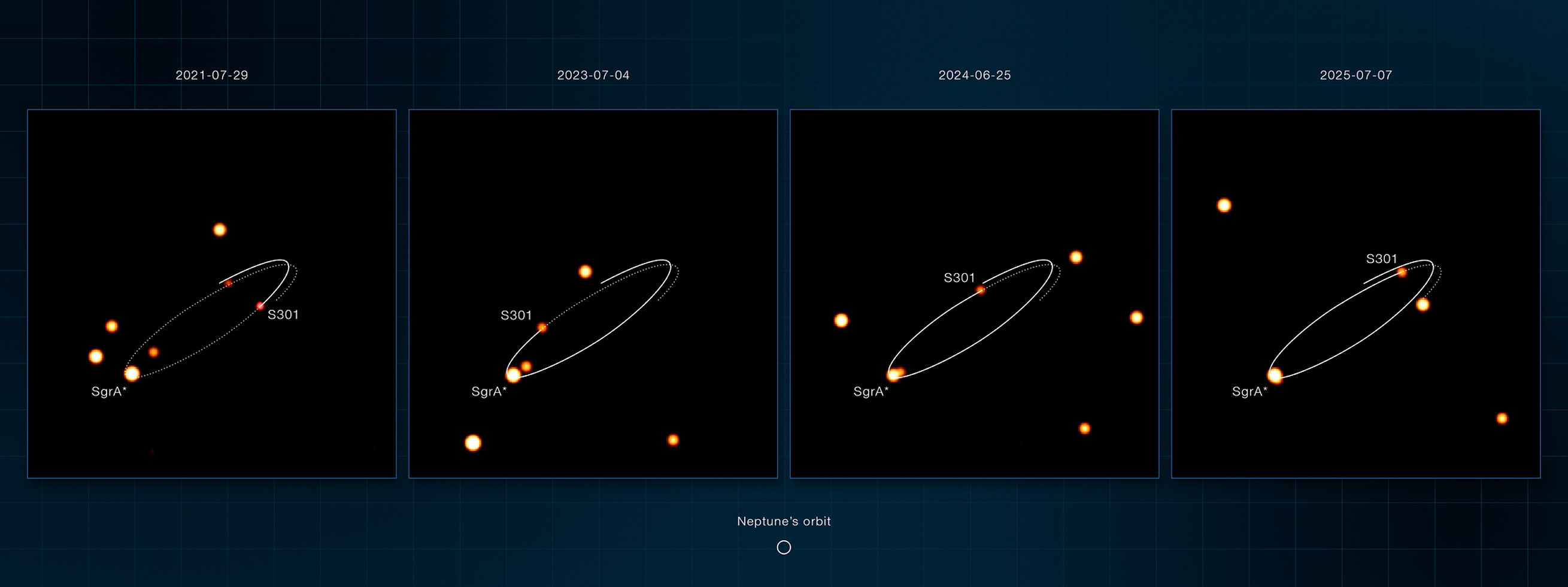
Using the GRAVITY instrument on ESO’s Very Large Telescope Interferometer, astronomers identified a faint main-sequence star called S301 orbiting Sagittarius A*, the roughly four-million-solar-mass black hole at the center of the Milky Way. Its orbit takes about 8.7 years. Near closest approach, S301 reaches roughly 25,000 kilometers per second, more than 8% of the speed of light.
That speed makes S301 the fastest known star in our galaxy. Its orbit also carries it extraordinarily close to Sagittarius A*, giving researchers a new object with which to test relativistic effects in the strongest gravitational environment currently accessible to precision stellar astrometry.
Why it matters
The most important part of the discovery is not the speed record by itself. S301’s compact orbit may eventually allow astronomers to measure Lense–Thirring frame dragging, the twisting of spacetime caused by a rotating mass. If GRAVITY+ and future Extremely Large Telescope observations become precise enough, the star’s trajectory could help constrain the spin of Sagittarius A*.
That spin has not been measured from S301 yet. The new work establishes an orbit that should be sensitive to the effect; detecting the tiny spin-dependent perturbation is a future observational challenge.
What the evidence supports
Evidence status: peer reviewed. The Nature paper strongly supports the measured orbit and extreme velocity. Confidence is high that S301 is the fastest known Milky Way star currently measured this way. The prospect of using it to determine black-hole spin is well motivated by relativity, but remains a forecast rather than a completed measurement.
REBELS-25 Was Already a Mature Rotating Disk 700 Million Years After the Big Bang
What happened
ALMA and JWST observations of the galaxy REBELS-25, seen at redshift 7.31, show warm ionized gas and colder neutral gas participating in ordered rotation. The system existed only about 700 million years after the Big Bang, yet the new analysis describes a chemically enriched, dusty and dynamically settled disk.
The measurements also suggest that a large fraction of its star formation is hidden by dust, with the study estimating roughly 55% to 98% of the activity could be obscured at ultraviolet wavelengths. That matters because surveys that depend heavily on unobscured starlight may underestimate what some young galaxies are doing.
Why it matters
Early galaxies are often expected to be turbulent systems still assembling rapidly through gas accretion, mergers and feedback. REBELS-25 shows that at least some massive galaxies developed ordered rotation and substantial enrichment surprisingly quickly. It does not overturn standard cosmology, but it gives galaxy-formation models a demanding early target to reproduce.
What the evidence supports
Evidence status: observational preprint submitted to Monthly Notices of the Royal Astronomical Society. Confidence is high that REBELS-25 contains an ordered rotating, dust-rich system. The larger question, whether similarly mature disks were common this early, requires a broader sample.
JWST Finds a Reflective Atmosphere on Lava World TOI-561b
What happened
JWST’s NIRSpec instrument watched the ultra-short-period rocky planet TOI-561b continuously for about 37 hours, following changes in infrared emission over a full orbital phase curve. The observations are best explained by a high Bond albedo and moderate redistribution of heat around the planet rather than an airless surface reradiating nearly all incoming energy locally.
Atmospheric circulation models show that reflective silicate clouds, including silica or magnesium-silicate condensates, could reproduce the observed brightness behavior. The result strengthens earlier evidence that this intensely irradiated rocky planet has managed to retain a global atmosphere.
Why it matters
Ultra-short-period rocky worlds receive punishing levels of stellar radiation and are often expected to lose substantial gaseous envelopes. TOI-561b suggests that hot rocky planets can be more complicated, potentially cycling volatile material between an atmosphere and a magma-rich interior. That gives astronomers another pathway to study the climate and evolution of worlds very different from Earth.
What the evidence supports
Evidence status: new observational analysis available on arXiv. The 37-hour JWST phase curve supports a reflective global atmosphere with moderate heat transport. The exact cloud composition and the idea that the interior continually replenishes atmospheric material remain model-dependent interpretations rather than direct detections.
Two Ancient Nova Shells May Surround U Geminorum
What happened
Deep hydrogen-alpha imaging with the Condor Array Telescope revealed two large, concentric shells centered on U Geminorum, the prototype dwarf nova. Models had previously predicted that U Gem should be surrounded by old nova ejecta, including a relatively recent eruption about a thousand years ago and shells roughly a degree across.
A Chinese record describes a “guest star” in November 829 CE whose timing and position are broadly consistent with one predicted eruption. The absence of matching Japanese and Korean records, however, weakens that historical identification.
Why it matters
If follow-up spectroscopy and expansion measurements confirm the structures as U Gem ejecta, this could be an unusual case in which very old nova shells were predicted before they were detected. The shells would preserve a physical history of repeated thermonuclear eruptions that occurred long before modern telescopes existed.
What the evidence supports
Evidence status: observational preprint. Confidence is high that the two imaged hydrogen-alpha structures exist. Their identification as U Gem nova shells is plausible but still provisional, and the specific connection to the 829 CE guest-star report is more uncertain.
Science News UFP Is Watching Closely
Several of this week’s stories now move into the follow-up phase. UFP will be watching for improved spectroscopy and expansion measurements of the U Gem shells, larger samples of very early rotating galaxies like REBELS-25, and future GRAVITY+ or ELT observations capable of extracting the tiny relativistic changes in S301’s orbit.
The biggest near-term event is NASA’s Nancy Grace Roman Space Telescope. NASA is targeting Roman’s launch for no earlier than 7:26 a.m. EDT on Sunday, August 30, aboard a SpaceX Falcon Heavy. Roman is designed to survey enormous areas of the sky for studies of dark energy, galaxies, exoplanets and other astrophysics targets. UFP will be watching the launch, commissioning milestones and the first science results that follow.
New observations can arrive quickly, but the useful science comes from seeing which interpretations survive better measurements. Check back with Unified Field Press throughout the week, and return each Friday for the Weekly Science Roundup covering the astronomy news, space science, astrophysics and latest science discoveries most worth following.
Latest From Unified Field Press
Our latest long-form video explains the deep August 27–28 partial lunar eclipse, why most of the Moon could turn copper-red without the eclipse becoming total, and how Earth’s atmosphere filters the light reaching the lunar surface. Watch the video below and explore the companion article: August 2026 Partial Lunar Eclipse: When and Why the Moon Turns Red.

About the Unified Field Press Weekly Science Roundup
The Unified Field Press Weekly Science Roundup highlights the most important and interesting developments in space science, astronomy, astrophysics, cosmology, planetary science and frontier physics. Rather than chasing every headline, we focus on a smaller number of stories where the observations, evidence or scientific implications make them worth understanding.
Whenever possible, reporting is checked against original research papers, mission teams, NASA, ESA, major observatories, universities and other authoritative sources. Preliminary observations, simulations, preprints and unresolved interpretations are identified clearly so emerging ideas are not presented as established facts.
Unified Field Press also produces deeper science articles and videos exploring the discoveries, missions and unanswered questions shaping our understanding of the universe. New science coverage appears throughout the week, with the Weekly Science Roundup bringing the biggest developments together every Friday.


Comments