
Webb Maps 12,523 Cosmic Filaments: Weekly Science Roundup — October 23, 2026
October 23, 2026 · By Unified Field Press
⠀
This week’s strongest science stories share a common lesson: the universe rarely hands us a complete picture. Researchers reconstruct hidden structure from uncertain galaxy distances, extract alien weather from a transit, distinguish a black hole’s behavior from an intervening cloud, and infer the composition of dust that vanished after passing the Sun.
⠀
The discoveries are compelling because each team also defines where observation ends and interpretation begins. That boundary is the focus of this week’s roundup.
⠀
⠀
The Week’s Big Picture
⠀
Across astronomy and space science, better analysis is turning familiar datasets into new kinds of maps. COSMOS-Web supplies a probability-weighted view of the cosmic web, while JWST transit data reveal structure around an exoplanet’s atmospheric rim rather than one averaged spectrum.
⠀
Closer to home, coordinated optical and X-ray observations show how geometry can make an active galaxy appear to switch off. Time-resolved images of interstellar comet 3I/ATLAS, meanwhile, constrain a short-lived population of icy grains that solar heating destroyed over tens of thousands of kilometers.
⠀
⠀
Webb Maps 12,523 Probable Filaments Across Cosmic Noon
⠀

⠀
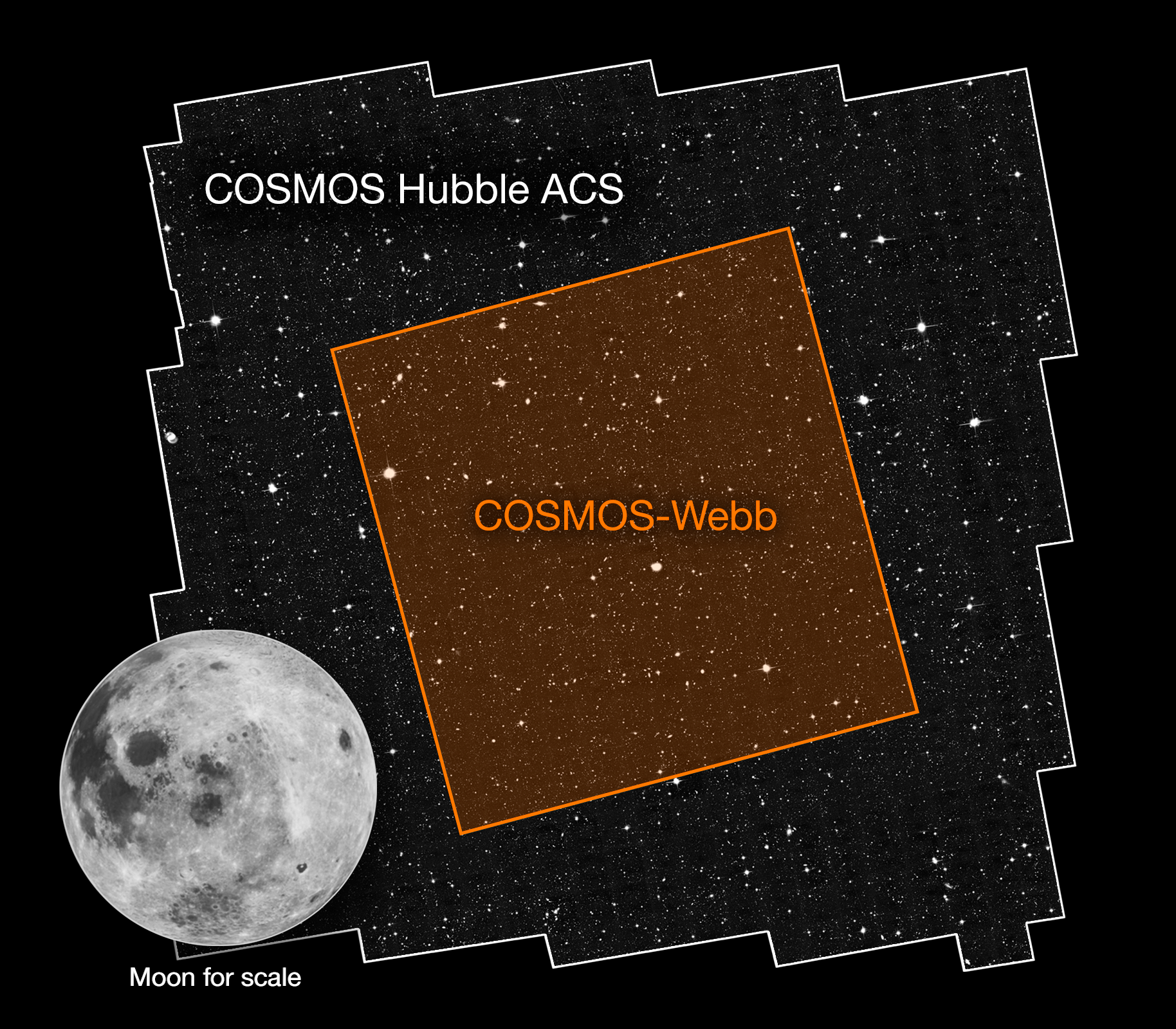
Image: The COSMOS field and the COSMOS-Web survey footprint. Credit: NASA, ESA, Jeyhan Kartaltepe (RIT), Caitlin Casey (UT Austin), Anton Koekemoer (STScI); graphic design: Alyssa Pagan (STScI). NASA source
⠀
What happened
⠀
Using COSMOS-Web Data Release 1, researchers built a catalog of 12,523 probable cosmic filaments spanning redshifts 0.5 to 3.5—the era that includes “cosmic noon,” when star formation and black-hole growth were near their peak. The structures are divided into 136,210 segments.
⠀
The team did not simply connect dots in a galaxy image. It repeatedly sampled each galaxy’s full photometric-redshift probability distribution, stacked the resulting two-dimensional realizations into filament-probability maps, and calibrated the extraction procedure against mock catalogs from IllustrisTNG simulations.
⠀
Why it matters
⠀
Filaments form the connective framework of the cosmic web. A uniform catalog through cosmic noon gives astronomers a practical way to test whether a galaxy’s distance from a filament, node, or void changes its gas supply, star formation, morphology, or black-hole activity.
⠀
The value is not only the headline number. The catalog and probability maps are reusable data products, so other teams can ask environmental questions without rebuilding the large-scale-structure reconstruction from scratch.
⠀
What the evidence supports
⠀
Evidence status: accepted for publication in Astronomy & Astrophysics. The galaxies are observed by Webb, but the filament locations are statistically reconstructed from uncertain distances and checked against simulations.
⠀
The result supports a robust projected map of recurring structure in the survey field. It is not a direct photograph of dark matter, not a complete three-dimensional map of the universe, and not proof of any single mechanism for forming the cosmic web. Spectroscopic redshifts will be especially important for testing projection-sensitive filaments.
⠀
⠀
JWST Turns a Transit Into a Map of an Alien Atmosphere
⠀
What happened
⠀
A peer-reviewed Nature Astronomy study applied a method called “transmission strings” to JWST observations of the hot Jupiter WASP-17 b. Instead of assuming one atmospheric radius around the entire planet, the method reconstructs how that radius changes with angle and wavelength around the limb.
⠀
The analysis finds a strong east–west contrast: a morning limb near 858 kelvin and an evening limb near 1,522 kelvin, with uncertainties that still leave a clear asymmetry. The hotter evening atmosphere is more extended, consistent with fast equatorial circulation carrying heat away from the permanent dayside.
⠀
Why it matters
⠀
Transit spectroscopy normally compresses a moving three-dimensional atmosphere into one average spectrum. Recovering spatial variation around the rim brings exoplanet observations closer to weather mapping and provides sharper tests of global-circulation models.
⠀
The technique also helps researchers avoid mistaking regional differences for planet-wide chemistry. In this case, reliably constrained water and carbon-dioxide abundances remain consistent around the limb even as the temperature and scale height change.
⠀
What the evidence supports
⠀
Evidence status: peer reviewed. JWST measured the transit light curves and spectra; the temperature field, shape, and circulation pattern are model-dependent reconstructions.
⠀
The evidence strongly supports an asymmetric atmospheric limb. It does not amount to a direct photograph or a complete global weather map, and the retrieval assumes north–south symmetry to reduce the problem’s complexity.
⠀
⠀
NGC 3227 Did Not Switch Off—A Dense Cloud Crossed the View
⠀
What happened
⠀
The nearby Seyfert galaxy NGC 3227 lost more than 70 percent of its optical continuum within weeks, while broad hydrogen-beta emission fell by about 80 percent. It recovered within two months. The accepted ApJ Letters paper combines optical monitoring, reverberation mapping, and Swift X-ray observations.
⠀
The broad-line region continued responding to the central continuum with a six-to-eight-day lag even during the dim state, while the X-ray spectrum hardened. Photoionization modeling requires a fully ionized, Compton-thick column near 1.5 × 10²⁴ particles per square centimeter, placing the best-supported obscurer inside the broad-line region.
⠀
Why it matters
⠀
Active galaxies can appear to change type because their central engine changes or because intervening material blocks what reaches us. NGC 3227 provides unusually coordinated evidence for the second explanation on a timescale short enough to track in detail.
⠀
The event is a reminder that brightness is not a simple meter for the power of a distant source. Geometry, absorption, and propagation through matter can imitate a dramatic change at the engine itself.
⠀
What the evidence supports
⠀
Evidence status: accepted for publication in The Astrophysical Journal Letters. The optical decline, emission-line response, and X-ray hardening are observed; the cloud’s density, ionization, and position come from reverberation and photoionization models.
⠀
Confidence is high that rapid obscuration drove this event. The cloud’s exact shape, origin, and path remain unresolved, and one galaxy cannot establish that every changing-look active nucleus behaves the same way.
⠀
⠀
Interstellar Comet 3I/ATLAS Shed a Vanishing Layer of Icy Grains
⠀
What happened
⠀
Zwicky Transient Facility images followed interstellar comet 3I/ATLAS before and after perihelion. A published Astrophysical Journal Letters study reports that the inner coma faded faster than the outer coma, while an unusually blue outer component appeared temporarily and later vanished.
⠀
The fading component extended roughly 64,000 to 72,000 kilometers in projection. Under the authors’ thermophysical assumptions, the scale and contemporaneous water production are consistent with icy grains about 5–10 micrometers across containing a small fraction of absorbing carbonaceous material.
⠀
Why it matters
⠀
This is a time-resolved look at material formed around another star responding to solar heating. The transient color, fading rate, and destruction length constrain physical grain properties more strongly than a single image of the coma could.
⠀
For planetary science, the study adds one more comparative point between extrasolar building material and Solar System comets. For science-fiction worldbuilding, it is also a useful reminder that a visible coma can be a changing population of particles rather than a fixed envelope around a nucleus.
⠀
What the evidence supports
⠀
Evidence status: peer reviewed and published in ApJ Letters. The coma’s brightness and color evolution are measured; grain size, composition, and mass-loss rate depend on the sublimation model, residence times, and assumed particle properties.
⠀
The evidence is consistent with short-lived volatile-bearing grains. It does not mean the grains were directly sampled, that every particle shared the inferred composition, or that the comet requires an artificial or exotic explanation.
⠀
⠀
Science News UFP Is Watching Closely
⠀
Next week, Unified Field Press will be watching for early uses of the COSMOS-Web filament catalog—especially studies that connect galaxy growth or black-hole activity to filament distance and independent checks using spectroscopic redshifts.
⠀
We will also follow repeat applications of transmission mapping to other exoplanets, new optical or X-ray monitoring of changing-look active galaxies, and independent dust or spectroscopic analyses that can narrow the icy-grain interpretation for 3I/ATLAS.
⠀
Return each Friday for the Weekly Science Roundup, where the week’s astronomy news, astrophysics, NASA news, cosmology, space science, and latest science discoveries are separated from the claims that still need more evidence.
⠀
⠀
Latest From Unified Field Press
⠀
Our latest standard long-form video explores why caregivers, veterans, and military families should document the details that memory can lose. Read the companion article, Why Caregivers and Veterans Should Document What Matters, then watch the video below. Return for new science explainers and long-form releases.
⠀
⠀
⠀
About the Weekly Science Roundup
⠀
Unified Field Press selects developments for scientific significance, evidence strength, public interest, visual potential, and lasting value. We check primary or authoritative sources, separate observation from interpretation, and label simulations, preprints, accepted manuscripts, and peer-reviewed results appropriately.
⠀
Our goal is not to make every result sound settled. It is to show what changed, why it matters, what the evidence actually supports, and what future measurements could overturn or strengthen the conclusion.
⠀
New science coverage appears throughout the week, and the Unified Field Press Weekly Science Roundup brings the biggest developments together every Friday.


Comments