
An AU-Scale Magnetic-Field Reversal May Be Bending Pulsar Signals - And It Echoes a Core Idea in UETC
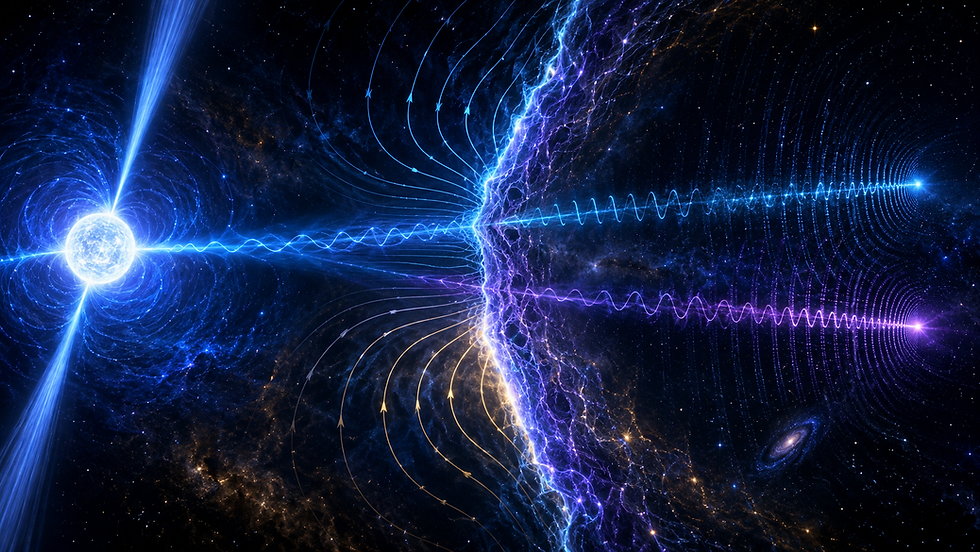
Space may look empty.
The signals crossing it tell a different story.
A new study submitted to arXiv on August 24, 2026, reports a striking new way of probing extremely small magnetic structures within the interstellar medium. Using the pulsar PSR B0834+06, researchers Jacob Yen, Daniel Baker, Dongzi Li, and Ue-Li Pen examined radio waves that appear to travel along separate paths through a tiny structure between the pulsar and Earth.
Tiny, at least, by astronomical standards.
The structure being investigated is on astronomical-unit scales, comparable to the distance between Earth and the Sun.
What the researchers found may allow astronomers to resolve something extraordinarily difficult to detect: a magnetic-field reversal occurring across an AU-scale interstellar current sheet.
But the result is interesting for another reason.
The observations provide a remarkably direct example of radiation responding to localized electromagnetic structure in the space through which it propagates.
That is also an idea at the heart of the framework developed in The Shape of Everything.
A Pulsar Turns Interstellar Space Into a Laboratory
Pulsars are rapidly rotating neutron stars whose magnetic fields produce remarkably regular pulses of radio emission.
Their extraordinary timing precision makes them useful for much more than simply studying neutron stars.
As those radio waves cross the interstellar medium, they encounter electrons, plasma structures, magnetic fields, and density variations between the pulsar and Earth.
Those structures can alter the signal.
The result is known as scintillation.
It is somewhat analogous to the twinkling of a star in Earth's atmosphere, although pulsar scintillation occurs because radio waves interact with structure in interstellar plasma rather than turbulent air above Earth.
Instead of treating those distortions merely as interference, astronomers can use them as information.
The distortion becomes a probe of what the signal encountered along the way.
Two Paths Through the Same Region of Space
The new study applies a technique called phase retrieval to polarized observations of PSR B0834+06.
The researchers were able to resolve a roughly one-millisecond scattering feature into two distinct branches in Doppler-delay space.
Under the study's corrugated current-sheet interpretation, those branches represent radiation traveling along two slightly different ray paths.
Those paths may be separated by approximately one AU.
That distinction is enormously useful.
Instead of receiving only one integrated measurement through a vast column of interstellar material, researchers may effectively be looking through two neighboring portions of the same small structure.
One path appears to sample one side of the proposed current sheet. The other samples the opposite side.
That creates an opportunity to ask whether the magnetic field changes between them.
Evidence for a Magnetic-Field Reversal
The researchers measured a difference in rotation measure between the two branches of:
(-9.3 +/- 3.2) x 10^-3 rad m^-2
Rotation measure tracks how magnetized plasma alters the polarization of radio waves passing through it.
The measured difference is consistent with a line-of-sight magnetic-field reversal of approximately:
4.4 +/- 2.1 microgauss
The result currently stands at approximately 2.9 sigma.
The authors therefore appropriately describe the experiment as a proof of concept rather than a definitive detection, particularly because the analysis contains only six independent frequency subbands.
That qualification matters.
But so does what has now become measurable.
Astronomers may be developing the ability to use pulsars to resolve magnetic structure on scales that are almost unimaginably small compared with the distances normally involved in astrophysics.
Space Between the Stars Has Structure
One of the easiest misconceptions about astronomy is that light simply crosses empty space until it reaches us.
Real astrophysical environments are considerably more complicated.
The interstellar medium contains plasma, electrons, magnetic fields, shocks, filaments, turbulence, density gradients, current sheets, and other structures.
Radiation moving through those environments can therefore acquire a history.
Its path can change. Its phase can change. Its polarization can change. Its arrival time can change.
In this study, two neighboring paths through an AU-scale region appear to carry different information about the electromagnetic environment through which they traveled.
The space separating source and observer is not simply an irrelevant gap.
It becomes part of the observation.
Where This Becomes Especially Interesting for UETC
Readers of The Shape of Everything will recognize an important conceptual overlap.
Unified Electromagnetic Toroidal Cosmology, or UETC, places considerable emphasis on the idea that electromagnetic structure should not always be treated as something merely sitting inside an otherwise featureless background.
Instead, the physical environment through which radiation propagates can itself possess structure.
One way The Shape of Everything expresses this is through the spatial quantity:
u(x) = c0^2 / c(x)^2
Here, c0 represents the reference propagation speed and c(x) represents the effective local propagation behavior associated with position.
The same expression can also be related to an effective refractive index:
n(x) = c0 / c(x)
which gives:
u(x) = n(x)^2
This provides a compact way of thinking about a spatially varying propagation environment.
If neighboring regions possess different electromagnetic or plasma conditions, then the propagation history of radiation passing through those regions need not be identical.
The New Observation Has Exactly That Kind of Geometry
Consider what is happening in the pulsar observation.
A radio signal begins at the same source. It encounters a localized structure. The radiation is resolved into separate propagation paths. Those paths sample different portions of the structure. They accumulate different polarization signatures. And those differences carry information about the electromagnetic configuration of the intervening region.
In simplified form:
electromagnetic structure -> different propagation environment -> different ray histories -> measurable signal
That is precisely why this study is so interesting when viewed alongside UETC.
The researchers themselves interpret the phenomenon using established magnetized-plasma physics and a corrugated current-sheet model.
UETC approaches the broader problem from another direction, asking whether spatially organized electromagnetic environments can be represented through a more general propagation framework such as u(x).
Those approaches do not need to be identical for the observational connection to matter.
The important point is that nature is giving us increasingly precise measurements of the very thing such models seek to describe: how electromagnetic structure and propagation are connected across space.
A Magnetic Reversal Is Not Necessarily a Reversal of u(x)
There is also an important distinction worth making.
The study is investigating a reversal in the direction of the magnetic field: B -> -B.
That does not mean the scalar quantity u(x) must itself reverse sign.
For example, electromagnetic energy terms often depend on quantities such as B^2.
Reversing the magnetic direction leaves the square unchanged: (-B)^2 = B^2.
The interesting u(x) structure would instead be associated with the spatial organization of the current sheet, plasma density, field energy, and gradients surrounding the reversal.
That distinction may ultimately be useful.
The magnetic orientation produces polarization information through effects such as Faraday rotation, while the density and geometry of the plasma structure contribute to refraction and scintillation.
In other words, the observation may contain multiple layers of information about the same physical structure.
Pulsars Could Become Maps of the Hidden Electromagnetic Landscape
If the technique demonstrated in this study can be extended to larger datasets and additional pulsars, its importance could go well beyond a single magnetic reversal.
The researchers note potential applications to cosmic-ray transport and to understanding propagation-induced noise affecting pulsar timing arrays.
It may also give astronomers something they rarely possess: a way of resolving extremely small electromagnetic structures scattered through interstellar space.
Instead of merely asking what exists between the stars, we may increasingly be able to map how that environment changes the signals passing through it.
And that could become an important observational frontier.
Because every pulsar signal arriving at Earth has crossed an enormous physical environment before reaching our instruments.
The distortions in those signals are not necessarily noise to be removed.
Sometimes they are the measurement.
The Bigger Question
The new study does not attempt to test Unified Electromagnetic Toroidal Cosmology directly.
But it does provide something extremely valuable for anyone interested in the physics explored in UETC: a real astrophysical system in which localized electromagnetic structure, spatial gradients, refraction, polarization, and propagation can potentially be measured together.
That opens a deeper question.
Can the observed current-sheet geometry be represented by a spatial u(x) profile?
And if so, could that same representation reproduce the observed scattering paths, delays, and polarization differences?
Those are testable questions.
As observations become increasingly capable of resolving the electromagnetic structure hidden between stars, frameworks describing how radiation interacts with that structure will have more opportunities to confront real data.
That is where the discussion becomes especially interesting.
The Universe May Be Telling Us More Through the Journey Than the Source
Astronomy has traditionally taught us to look toward the object emitting the light: the star, the pulsar, the galaxy, or the black hole.
But some of the most revealing information may be encoded in what happens between the source and the observer.
PSR B0834+06 sent out its radio pulses long ago.
Before those signals reached Earth, they crossed a structured electromagnetic environment.
Two neighboring paths appear to have experienced that environment differently.
And by measuring the difference, researchers may have detected the signature of a magnetic reversal across an AU-scale interstellar structure.
The universe is not merely filled with objects.
It is filled with structure between those objects.
And sometimes, the path itself is the experiment.
Explore the Framework Behind u(x)
The Shape of Everything: The Hidden Geometry of the Electromagnetic Universe explores Unified Electromagnetic Toroidal Cosmology and the recurring relationship between electromagnetic fields, geometry, propagation, plasma behavior, and large-scale cosmic structure.
The book develops the u(x) framework in greater detail and examines how electromagnetic organization may appear across scales, from laboratory and planetary systems to stars and the larger universe.
If discoveries like AU-scale interstellar current sheets, plasma lenses, magnetic reversals, and structured propagation make you wonder whether space is telling us something deeper about its electromagnetic architecture, The Shape of Everything was written to explore exactly that question.

Read The Shape of Everything
Available now on Amazon in paperback and Kindle editions.
Read the Research
Jacob Yen, Daniel Baker, Dongzi Li, and Ue-Li Pen: Probing AU-Scale Magnetic-Field Reversals in the Interstellar Medium with Pulsar Scintillation. Submitted August 24, 2026.


Comments