

Could Cosmic Plasma Change the Light We See from Distant Galaxies?
The universe is filled with moving plasma, magnetic fields, and gravitational structures. Could they be influencing the light we use to understand the cosmos?
Every photon arriving at Earth has a story to tell.
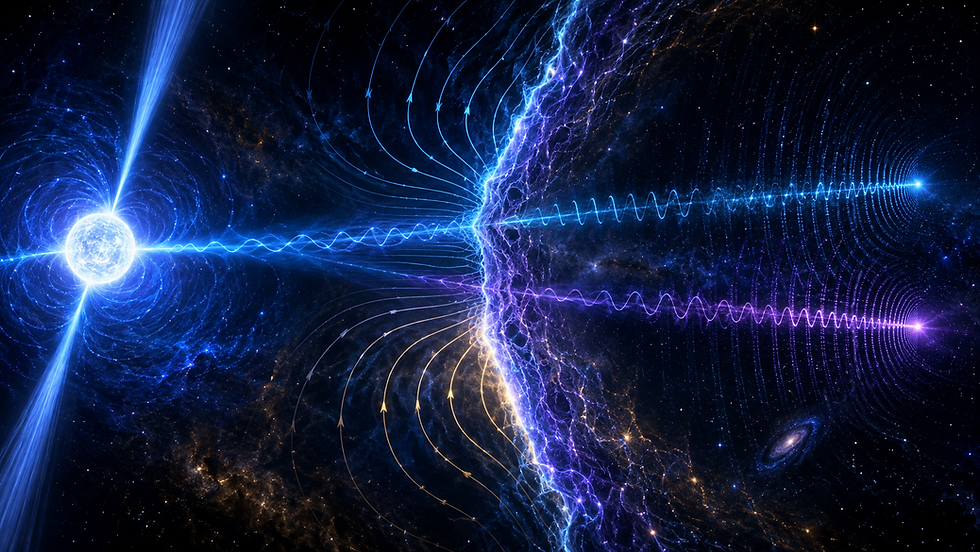
Some have traveled for billions of years, crossing enormous cosmic filaments, gravitational fields, and regions of electrically charged plasma.
Along the way, their paths may have bent. Their frequencies may have shifted. Their polarization may have changed.
Astronomers study these signals to reconstruct the history of the universe, measure its expansion, and understand distant galaxies.
But consider something intriguing.
What if the light reaching us has been shaped by more than the distance it traveled?
What if the universe itself has left subtle signatures on that light throughout its journey?
And could some of those signatures be connected to the enormous electromagnetic structures surrounding us?
A Universe Dominated by Plasma
We often imagine space as an enormous vacuum, interrupted occasionally by stars, planets, and galaxies.
But the universe is far more active than that picture suggests.
More than 99% of the visible matter in the universe is commonly estimated to exist in a plasma state. This refers to ordinary visible matter, rather than dark matter or dark energy.
Plasma is sometimes called the fourth state of matter, but on cosmic scales, it is anything but unusual.
Stars, stellar atmospheres, and much of the material occupying interstellar and intergalactic space contain ionized particles.
Unlike ordinary neutral gas, plasma contains free electrons and ions that respond to electromagnetic forces.
As charged particles move, they can generate electrical currents and magnetic fields. Those fields, in turn, influence how the plasma moves.
The result is a remarkable relationship between matter and electromagnetism.
Across the universe, plasma forms enormous filaments, rotating disks, magnetic loops, and powerful jets extending thousands of light-years into space.
These structures are not simply suspended in an otherwise motionless universe.
They flow. They rotate. They interact.
And their movement raises an interesting question.
What happens when vast amounts of electrically charged matter move through the fabric of spacetime?
When Electromagnetism Meets Einstein
More than a century ago, Albert Einstein transformed our understanding of gravity.
Mass and energy do not simply attract one another. They influence the geometry of spacetime itself.
But there is another consequence of general relativity that receives far less attention.
Rotating mass-energy can influence the surrounding spacetime through a phenomenon known as frame-dragging.
This effect has been measured around Earth and becomes considerably more pronounced near rapidly spinning black holes.
Now consider the universe's enormous quantities of circulating plasma.
Plasma possesses mass and energy. When it moves, it carries momentum. Its electromagnetic fields can also carry energy and angular momentum.
Under general relativity, all of these quantities contribute to spacetime curvature.
Meanwhile, the electromagnetic fields associated with plasma can leave their own signatures on passing radiation.
Astronomers observe such effects in fast radio bursts, whose signals can be dispersed and polarized by intervening plasma and magnetic fields.
These electromagnetic effects are distinct from gravitational frequency shifts, but together they reveal something fascinating.
The universe is filled with moving matter, electromagnetic energy, and gravitational structures, all capable of influencing the environment through which light travels.
We understand many of these interactions individually.
But how completely do we understand their combined influence across cosmic distances?
And what might happen to a photon passing through such an environment?
Can a Photon Gain or Lose Energy Along Its Journey?
We know that gravity can change the frequency of light as measured by observers.
A photon moving into a gravitational potential can become blueshifted, while one climbing out can become redshifted.
These changes are not merely theoretical.
Gravitational redshift has been measured experimentally, and astronomers routinely account for gravitational effects when interpreting light from distant objects.
But a particularly fascinating possibility emerges when gravitational environments change while light travels through them.
Under the right circumstances, a photon can experience a net frequency shift as it crosses an evolving gravitational structure.
A related phenomenon, the Integrated Sachs–Wolfe effect, has been observed statistically in the cosmic microwave background.
This demonstrates something important.
The changing gravitational landscape of the universe can leave an imprint on the light passing through it.
Now imagine a photon traveling billions of light-years.
How many gravitational structures might it encounter?
How many regions of moving plasma?
How many magnetic fields, rotating systems, and evolving concentrations of matter?
Not every encounter changes its final frequency. Many effects cancel, and others are extraordinarily small.
But the journey is not necessarily without consequence.
Redshift, Blueshift, and the Bigger Picture
When astronomers examine distant galaxies, one of the most important measurements is redshift.
The farther away a galaxy is, the greater its redshift generally appears.
Modern cosmology explains this dominant relationship through the expansion of space, an interpretation supported by several independent lines of evidence.
Yet expansion is not the only phenomenon capable of changing the frequency of light.
Motion can produce Doppler shifts. Gravity can produce redshift and blueshift. Evolving gravitational structures can leave additional imprints.
These effects are understood individually, although determining their contributions to particular observations can be challenging.
Frame-dragging itself does not automatically cause photons to accumulate a permanent redshift or blueshift. Whether rotating systems produce additional observable frequency changes depends on their geometry and evolution.
Still, consider the broader picture.
We observe a universe filled with charged matter in motion.
That motion can generate electromagnetic fields.
Moving mass-energy and electromagnetic fields contribute to spacetime curvature.
And the geometry of spacetime influences the propagation of light.
These relationships are not hypothetical. They are parts of established physics.
The unanswered question is how deeply interconnected their effects might be on cosmic scales.
What Else Might the Universe Be Telling Us?
Perhaps some of the most interesting questions in cosmology lie not in discovering entirely new forces, but in exploring connections between phenomena we already know exist.
Plasma flows.
Magnetic fields organize matter.
Rotating energy influences spacetime.
Light carries information across extraordinary distances.
Each of these statements describes something real about our universe.
But together, they invite a much larger question.
What if electromagnetic circulation, cosmic structure, and the geometry of spacetime are more closely connected than we currently recognize?
What might we discover by examining those relationships as parts of a larger system?
These are among the ideas explored in The Shape of Everything: The Hidden Geometry of the Electromagnetic Universe.
The book introduces Unified Electromagnetic Toroidal Cosmology (UETC), a speculative framework that explores possible relationships between plasma dynamics, magnetic structures, cosmic circulation, and the geometry of the universe.
It invites readers to look beyond individual phenomena and consider how familiar physical principles might contribute to a larger picture.
Because perhaps the most compelling question is not simply how far a photon has traveled.
It's what the universe has done to that photon along the way.
Explore these ideas further in The Shape of Everything: The Hidden Geometry of the Electromagnetic Universe, available through Unified Field Press.

Comments