

How IceCube Opened the High-Energy Neutrino Universe
The 2026 Nobel Prize in Physics recognizes a detector unlike any conventional telescope: thousands of light sensors buried deep inside a cubic kilometer of Antarctic ice.
The prize was awarded to Francis Halzen for decisive contributions to the IceCube Neutrino Observatory and the discovery of high-energy neutrinos arriving from astrophysical sources. It honors the creation of a new form of astronomy rather than a new neutrino detection made this week.
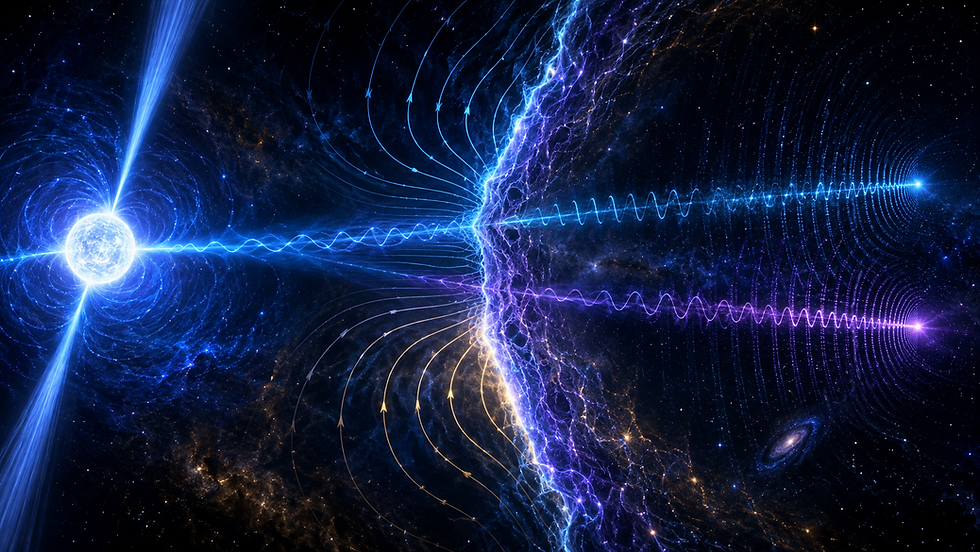
Cover image: a generated scientific illustration of IceCube’s detector geometry, not an observational photograph.
A Telescope Built Beneath the South Pole
IceCube is constructed from long vertical strings of optical modules embedded more than two kilometers beneath the Antarctic surface. Together, those sensors instrument roughly one cubic kilometer of clear ice.
Most neutrinos pass through matter without interacting. On rare occasions, one collides with an atom in the ice and produces a fast charged particle. That particle emits a cone of blue Cherenkov light, allowing IceCube’s sensors to reconstruct its direction and energy.
In effect, the Antarctic ice is both the detector medium and part of the instrument. Instead of focusing visible light with mirrors, IceCube measures brief flashes produced by particles that may have crossed enormous cosmic distances—and sometimes traveled through Earth before reaching the array.
Why Neutrinos Reveal a Different Universe
Light can be absorbed, scattered or blocked by dense matter. Charged cosmic rays are bent by magnetic fields, which makes their origins difficult to trace. Neutrinos carry no electric charge and interact only weakly, so they can escape environments that are opaque to ordinary telescopes and preserve information about their direction of travel.
That makes high-energy neutrinos valuable messengers from extreme systems: active galactic nuclei, stellar explosions and other environments capable of accelerating particles to extraordinary energies.
IceCube reported compelling evidence for a population of astrophysical high-energy neutrinos in 2013. Later work associated neutrino emission with the blazar TXS 0506+056, the active galaxy NGC 1068 and the Milky Way itself.
What the Nobel Prize Actually Recognizes
The award recognizes Halzen’s scientific leadership and decisive contributions to making IceCube possible. It also reflects decades of work by the international collaboration that designed, constructed, calibrated and operated the observatory.
This distinction matters. The Nobel announcement is not evidence that one individual built the experiment alone, and it does not introduce a previously unknown particle. It recognizes the establishment of high-energy neutrino astronomy as a working observational field.
IceCube now complements electromagnetic observatories, gravitational-wave detectors and cosmic-ray experiments. When more than one messenger is detected from the same source, researchers can test models that would remain ambiguous using light alone.
From Antarctic Ice to Cosmic Accelerators
One of IceCube’s central goals is identifying the engines that produce the universe’s highest-energy particles. Because cosmic rays are electrically charged, magnetic fields scramble their trajectories before they reach Earth. Neutrinos produced near those accelerators travel almost straight to us.
A neutrino does not automatically provide a complete or unique identification. Its directional reconstruction has uncertainty, and many candidate sources may occupy the same area of sky. Reliable interpretation often requires coordinated observations at radio, optical, X-ray and gamma-ray wavelengths.
That is why IceCube’s most important contribution is not a single spectacular event. It is the addition of an entirely different information channel to astronomy.
What Comes Next for IceCube
The IceCube Upgrade was deployed during the 2025–2026 Antarctic season, with its first science data expected later in 2026. Its denser instrumentation is intended to improve calibration and lower the detector’s energy threshold.
IceCube-Gen2 is a proposed future expansion that would instrument a much larger volume of ice and substantially improve sensitivity to the highest-energy neutrinos. It remains a proposed observatory rather than a completed instrument, so projected performance should be treated as a forecast.
Evidence Status and Confidence
Evidence status: Nobel Prize and agency announcement dated October 6, 2026. The underlying IceCube results are established through peer-reviewed observational research.
Confidence: Very high that IceCube opened high-energy neutrino astronomy and detected an astrophysical neutrino population. Confidence varies for individual source associations, which require statistical and multiwavelength confirmation.
Important limitation: The Nobel announcement is recognition of an established body of work—not a new source detection, proof of a particular cosmological model or evidence for UETC.
Primary Sources
Unified Field Press covers space, physics and cosmology with careful separation between observation, interpretation and speculation.


Comments