
Planck Data Reveal a Toroidal Magnetic Field Around the Milky Way
August 11, 2026 · Unified Field Press
The Milky Way is not just a disk of stars, gas, and dust. It is also threaded by magnetic fields extending far above and below the visible Galaxy. A new analysis of ESA’s Planck data now argues that one large-scale part of that field is both stronger and more organized than earlier measurements alone suggested.
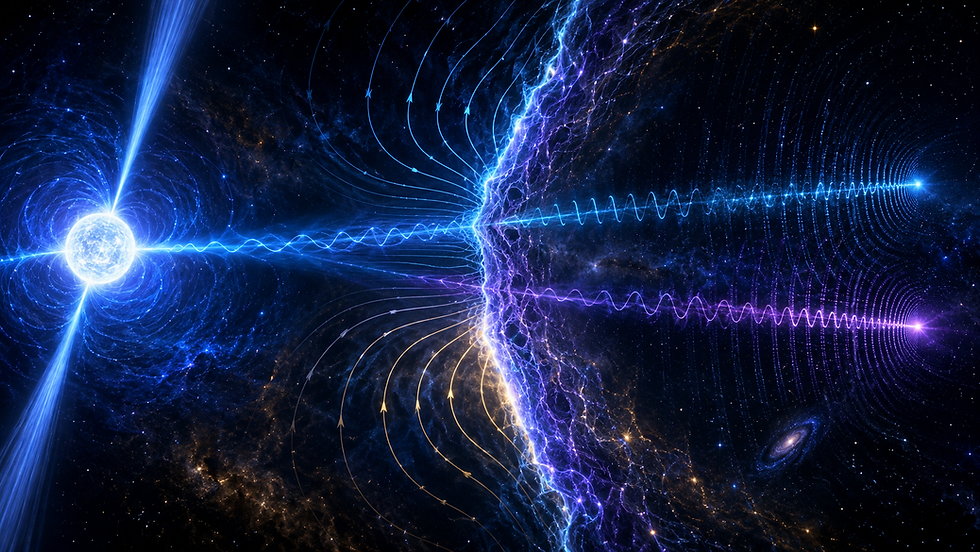
The cover image is an earlier ESA/Planck visualization of Galactic magnetism traced with polarized dust emission. It provides visual context for the Milky Way’s magnetic structure; the new study itself analyzes Planck 30 GHz polarized synchrotron emission.
A Magnetic Structure Wrapped Around the Galaxy
The new study, by Elena Orlando, compares Planck’s 30 GHz synchrotron polarization maps with models that treat cosmic-ray electrons and Galactic magnetic fields together. The work has been accepted for publication in Astronomy & Astrophysics.
The key result is an excess of large-scale polarized synchrotron emission compared with what the existing magnetic-field model predicts. To reproduce the observations, the analysis requires an additional ordered toroidal magnetic-field component in the Galactic halo with a peak strength of roughly 3.2 to 4.3 microgauss, depending on the assumed size of the cosmic-ray propagation halo.
“Toroidal” here means that the field has a large-scale component organized around the Galaxy rather than simply pointing outward from it. It does not mean that every magnetic structure in the Milky Way is a perfect ring, and it does not imply that the Galaxy is enclosed by a rigid magnetic shell.
Why Planck Sees More Field Than Rotation Measures
One of the most interesting parts of the result is the difference between what different measurement techniques reveal. Faraday rotation measures are particularly sensitive to the coherent component of the magnetic field along a line of sight. But polarized synchrotron emission can also trace magnetic structure that remains directionally ordered even if the field reverses on scales that partially cancel in a rotation-measure observation.
The paper concludes that the total ordered field inferred from the Planck polarization maps is about four to six times stronger than the coherent field inferred from the rotation-measure model used in the analysis. That points to a substantial ordered-random component: a field that has large-scale organization but contains reversals that make it harder to see with some techniques.
That distinction matters. Two instruments can look at the same physical environment and produce different apparent field strengths without either measurement being wrong. They are sensitive to different properties of the same magnetic system.
Cosmic Rays Make the Measurement More Complicated
Synchrotron radiation is produced when relativistic charged particles move through magnetic fields. That means astronomers cannot infer the field strength from synchrotron emission without also understanding the cosmic-ray electrons generating the radiation.
The new work attempts to solve that problem self-consistently. Its cosmic-ray models are constrained by direct particle measurements and multifrequency observations, while the magnetic-field configuration is adjusted to reproduce the Planck polarization data. The study finds that a cosmic-ray propagation halo about 4 kiloparsecs in size is favored by the Planck synchrotron maps within the tested models.
This is important for more than Galactic magnetism. Magnetic fields determine how charged cosmic rays diffuse and propagate through the Milky Way, so changing the assumed halo field can influence models used to interpret gamma rays, radio emission, energetic particles, and searches for more exotic phenomena.
Could the Local Bubble Explain It Instead?
The Sun sits inside a large, low-density cavity in the interstellar medium known as the Local Bubble. Because nearby magnetized material can contaminate all-sky measurements, the study also examined whether the polarization excess might be produced locally rather than by a broad Galactic-halo field.
The author finds that attributing the entire excess to the Local Bubble would require non-standard properties for the Bubble. That does not make local contamination irrelevant, but within the models tested it makes the extended ordered halo field the preferred explanation.
What the Result Does — and Does Not — Establish
This is an accepted scientific result built from observational data, but the toroidal field strength is still a model-dependent inference. It depends on assumptions about cosmic-ray electron distributions, halo size, foreground structure, and the magnetic-field configuration used in the calculation. Future measurements can refine those assumptions and test whether the inferred component remains as strong.
The result is particularly interesting for Unified Field Press because it demonstrates a real, observationally constrained example of large-scale toroidal magnetic organization. UETC places significant emphasis on toroidal electromagnetic structures across physical scales. This observation may be consistent with that broad structural interest, but it does not prove UETC, establish a universal toroidal geometry, or require physics beyond conventional Galactic magnetism and cosmic-ray transport.
Why This Matters Beyond the Milky Way
Large-scale magnetic fields are not decorative features added to galaxies after everything else is understood. They affect charged-particle motion, plasma behavior, synchrotron radiation, and the interpretation of signals crossing enormous distances. The more accurately astronomers can map those fields, the better they can separate the physics of the source from the physics of the medium through which the signal travels.
That is also why this result fits naturally into the questions explored in The Shape of Everything: how field structure, propagation, and observation interact across scales. Explore The Shape of Everything on Amazon.
Primary Sources
Image credit: ESA and the Planck Collaboration. ESA Standard Licence.
Unified Field Press · Science, physics, space, and the structure of the universe.


Comments